

















CJC 1295 UK Testing Laws and DAC Secrets Revealed
CJC-1295 UK and Research Peptides UK: DAC, No DAC, Testing and the Evidence
CJC-1295 is a long-acting growth hormone-releasing hormone analogue with a clever molecular feature: it was designed to attach to circulating albumin. That single modification changed its pharmacology and created one of the most persistent naming confusions in the UK peptides market.
CJC-1295 UK Scientific Summary
CJC-1295 was developed as a longer-acting analogue of the biologically active portion of human growth hormone-releasing hormone. Its defining Drug Affinity Complex, usually shortened to DAC, was designed to form a covalent bond with endogenous albumin after entering the circulation. 1
Small studies in healthy adults reported prolonged increases in circulating growth hormone and IGF-1 after CJC-1295 exposure. The studies were early stage, included limited participant numbers and did not establish the broad recovery, physique or anti-ageing claims now seen online. 2
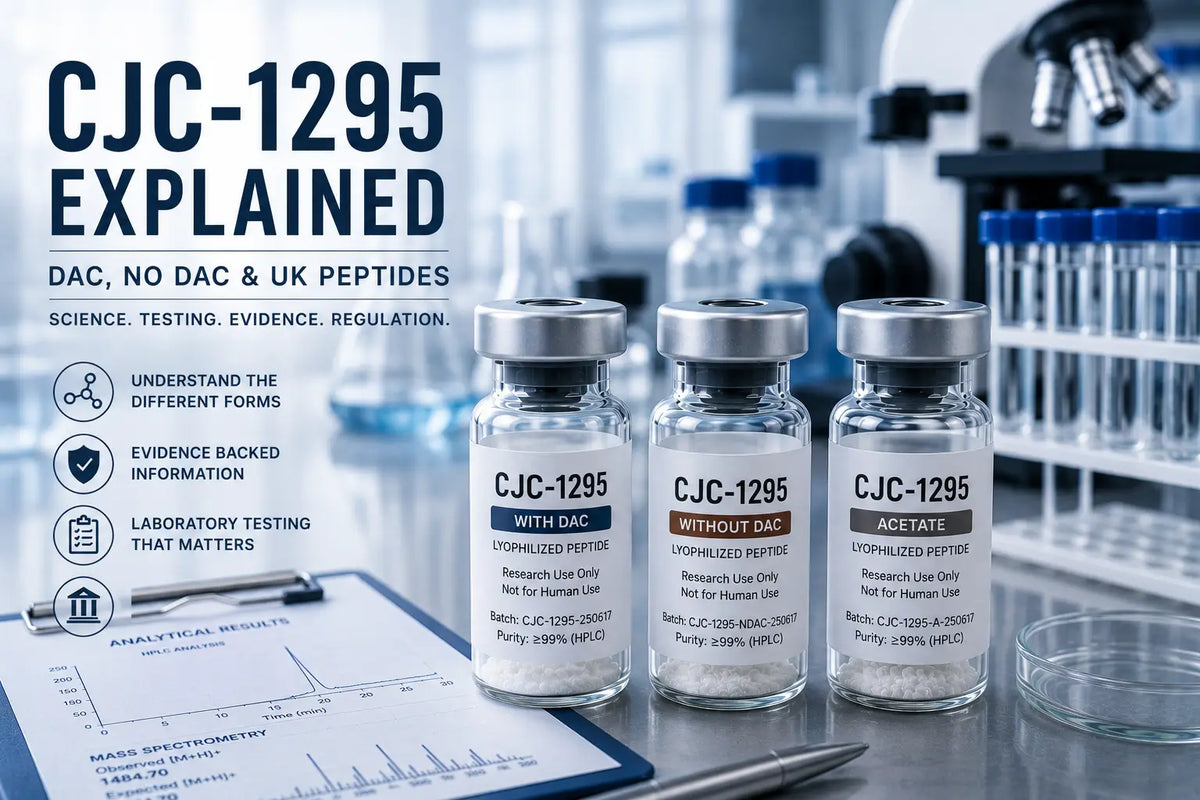
The scientific name CJC-1295 properly refers to the DAC-containing molecule. “CJC-1295 no DAC” is widespread supplier language for Modified GRF 1-29, a related but chemically different peptide without the albumin-binding extension.
In plain English: CJC-1295 is a modified signalling peptide designed to remain active for longer by attaching to a common blood protein. Remove the DAC feature and the material is no longer the same long-acting molecule studied under the CJC-1295 name.
Current evidence at a glance
Small controlled studies
No authorised indication established
Albumin binding is well described
What Is CJC-1295 Peptide UK Research About?
To understand CJC-1295, begin with GHRH, then look at the four residue substitutions and the DAC extension.
Human growth hormone-releasing hormone, also called GHRH or GRF, is a hypothalamic signal that binds to receptors on pituitary somatotroph cells. The first 29 residues retain substantial biological activity, which is why Sermorelin and several research analogues are based on GHRH 1-29.
CJC-1295 uses a modified 1-29 core. Four residue positions are changed to increase resistance to enzymatic breakdown. A lysine is then added at position 30 and equipped with a maleimide-containing Drug Affinity Complex that reacts with albumin. 1
PubChem lists CJC-1295 under CID 91971820 and records the formula C165H269N47O46 for the defined DAC-containing compound. 3

Review focus: keeping the GH and IGF-1 discussion biologically accurate while avoiding the common mistake of converting hormone changes into guaranteed body-composition or performance outcomes.
CJC-1295 With DAC UK
“CJC-1295 with DAC” is a commercially useful phrase, although the original research compound already includes DAC. The added phrase helps distinguish the long-acting albumin-binding molecule from products advertised as CJC-1295 no DAC.
CJC-1295 No DAC UK
In the online UK peptides market, CJC-1295 no DAC commonly means Modified GRF 1-29. This material uses the four stabilising substitutions but does not contain the extra DAC-bearing lysine.
The distinction affects molecular identity, expected mass, analytical method, pharmacokinetics and the interpretation of a Certificate of Analysis. It is not a minor branding choice.
Interactive CJC-1295 Molecular Structure Explorer
Switch between the defined DAC-containing CJC-1295 molecule and the shorter material often sold as CJC-1295 no DAC. This simplified primary-structure diagram highlights the four core substitutions and the DAC attachment site.
CJC-1295 with DAC
The defined molecule contains a modified GRF 1-29 core and an added lysine at position 30 carrying the reactive DAC group.
- Four stabilising substitutions in the 1-29 core
- Extra lysine at position 30
- Maleimide-containing albumin-binding feature
How Does CJC-1295 Work?
The interactive pathway separates receptor signalling from the albumin-binding feature that extends exposure.
Albumin Binding
The DAC feature reacts with circulating albumin after exposure.
GHRH Receptor
The peptide core activates the GHRH receptor on pituitary cells.
GH Secretion
Pituitary signalling increases growth hormone output in experimental studies.
IGF-1 Axis
Growth hormone can increase hepatic and peripheral IGF-1 signalling.
Does CJC-1295 Preserve Growth Hormone Pulses?
A 2006 study reported that pulsatile growth hormone secretion persisted during prolonged CJC-1295 stimulation. Mean, trough and pulsatile GH secretion increased rather than becoming a simple flat line. 4
That observation is scientifically interesting, but it does not prove that prolonged experimental elevation is beneficial for healthy people or that a supplier vial reproduces the study material.
A measurable rise in a biological marker is evidence of pharmacological activity. It is not, by itself, evidence of a desirable personal outcome.

Review focus: distinguishing an endocrine biomarker change from proven clinical benefit, and ensuring that early human studies are not presented as broad treatment evidence.
CJC-1295 Research Timeline
Select a milestone to follow the compound from albumin-binding experiments to current regulatory scrutiny.
Long-Acting Analogue
Animal research described albumin bioconjugation and GHRH-receptor activity.
Healthy Adults
Early human work measured prolonged GH and IGF-1 responses.
Pulse Study
Researchers examined whether GH pulsatility persisted during prolonged stimulation.
Phase 2 Record
A trial was registered in HIV-associated visceral obesity.
Safety Scrutiny
FDA and WADA sources highlighted safety, characterisation and anti-doping concerns.
Why Albumin?
Albumin circulates for a comparatively long time and is abundant in blood. Linking a small peptide to albumin can reduce rapid kidney filtration and protect against some forms of enzymatic clearance.
An Investigational Programme, Not an Approved Product
CJC-1295 entered early clinical development and a phase 2 study was registered. The programme did not produce a UK-authorised medicine.
CJC-1295 Studies and Evidence Strength
Use the tabs to separate molecular evidence, animal research, early human pharmacology, clinical-development evidence and regulatory status.
Molecular identity
The DAC-containing compound has a defined chemical identity, albumin-binding mechanism and public molecular record. This does not authenticate every product carrying the name CJC-1295.
What the Human Studies Actually Found
Prolonged GH and IGF-1 Responses
A small randomised study reported dose-dependent and prolonged increases in GH and IGF-1 after single and repeated exposure in healthy adults. 2
Pulsatility Was Retained
Researchers reported increased total and pulsatile GH secretion during continuous CJC-1295 stimulation. 4
Serum Protein Changes
A later analysis examined protein-profile changes associated with activation of the GH and IGF-1 axis. This was exploratory biomarker work rather than evidence for consumer outcomes. 5
HIV-Associated Visceral Obesity
ClinicalTrials.gov records a multicentre phase 2 study designed to assess efficacy, pharmacokinetics, safety and tolerability. A trial record is evidence that research was planned, not proof of an approved indication. 6
What CJC-1295 Research Does Not Establish
- That CJC-1295 improves recovery, muscle gain, sleep or fat loss in healthy consumers
- That CJC-1295 with DAC and CJC-1295 no DAC are interchangeable
- That CJC-1295 and Ipamorelin combinations have been validated in large controlled trials
- That a supplier’s high HPLC percentage proves the correct DAC attachment
- A complete long-term human safety profile
- A current UK marketing authorisation
- That an online research vial matches the material used in the original studies

Review focus: ensuring that limited human pharmacology is described accurately and does not drift into treatment language, personal recommendations or implied endorsement.
CJC-1295 UK Compared with Related UK Peptides
Supplier catalogues often place these names together, but receptor pathway, sequence, duration and evidence history differ.
| Material | General identity | Primary receptor context | Key distinction |
|---|---|---|---|
| CJC-1295 with DAC | Modified GHRH analogue with albumin-binding DAC | GHRH receptor | Long-acting defined research compound |
| Modified GRF 1-29 | Modified 29-residue GHRH fragment without DAC | GHRH receptor | Often marketed as CJC-1295 no DAC |
| Sermorelin | Amidated GHRH 1-29 fragment | GHRH receptor | Lacks the four CJC core substitutions and DAC |
| Tesamorelin | Modified GHRH analogue | GHRH receptor | Different sequence, development history and authorised uses outside the UK context discussed here |
| Ipamorelin | Synthetic pentapeptide secretagogue | Ghrelin receptor | Uses a different receptor pathway |
| GHRP-2 | Synthetic growth hormone-releasing peptide | Ghrelin receptor | Not a GHRH analogue |
CJC-1295 With DAC vs CJC-1295 No DAC
| Question | CJC-1295 with DAC | Material sold as CJC-1295 no DAC |
|---|---|---|
| Core | Modified GRF 1-29 | Modified GRF 1-29 |
| Position 30 | Added lysine carrying DAC | No DAC-bearing lysine extension |
| Albumin binding | Designed for covalent attachment | Not designed with the same DAC mechanism |
| Expected mass | Higher and modification-dependent | Lower, corresponding to the 29-residue analogue |
| Best scientific name | CJC-1295 or CJC-1295 with DAC | Modified GRF 1-29 |
| Can one COA cover both? | No | No |
CJC-1295 Testing: How Laboratories Confirm Identity
CJC-1295 testing must answer a question that basic purity testing cannot: is the DAC-bearing modification present in the correct form and position?
HPLC or UHPLC
Chromatography can separate detectable components and report the relative area of the main peak under a defined method.
LC-MS or High-Resolution MS
Mass spectrometry can assess whether the observed material is consistent with the expected modified molecule.
Peptide Mapping and MS/MS
Fragment analysis can add evidence for sequence order, the four substitutions and the modified C-terminal region.
Modification-Specific Characterisation
A complete claim should account for the maleimidopropionyl group and its attachment to the added lysine.
Net Peptide Assay
Net peptide content should be separated from total dried mass, water, counterions and residual synthesis material.
Related Substances
Truncations, oxidation, hydrolysis, incorrect attachments, deletion sequences and aggregates may require targeted evaluation.
Analytical confidence
Purity context only
Supports molecular identity
Sequence and quantity context
What Should a CJC-1295 UK Certificate of Analysis Include?
- The exact product identity, including whether DAC is present
- The full sequence or unambiguous modification nomenclature
- The expected molecular form and expected mass
- The observed mass and method
- The HPLC or UHPLC method and chromatogram
- The batch number and analysis date
- The issuing laboratory and report identifier
- The quantity basis, including net peptide where available
- Any counterion, water or residual-solvent results
- A statement of the tests not performed
Why 99% HPLC Does Not Prove CJC-1295 With DAC
A 99% peak-area result does not automatically prove:
- That the main peak is CJC-1295
- That the DAC group is present
- That the DAC group is attached at the intended site
- That all stereochemical and sequence features are correct
- The net quantity in the vial
- Sterility, endotoxin level or microbial quality
- Equivalence to a historical clinical-study batch
- Suitability for administration

Review focus: translating the distinction between chromatographic purity, molecular identity and complete quality assessment into language a non-scientist can follow.
How to Compare CJC-1295 Suppliers UK
People who search “buy CJC-1295 UK” encounter pages with similar claims, but the documents behind those claims vary considerably. This section is an educational due-diligence framework, not a product recommendation.
Traceable UK Business
Check the legal company name, address, contact route and transparent terms.
DAC Status Stated Clearly
The page should not leave readers guessing whether the material is CJC-1295 or Modified GRF 1-29.
Complete Molecular Identity
“CJC 5 mg” or a stock code is not an adequate scientific description.
Matching Batch Records
The label, invoice and analytical report should refer to the same lot.
Identity Plus Purity
Look for suitable mass or sequence evidence alongside chromatography.
Clear Quantity Basis
The supplier should distinguish net peptide from total dried material.
No Personal Protocols
A research page should not provide cycles, stacking plans or injection instructions.
Recall Capability
A responsible business should be able to trace, investigate and recall a disputed batch.
CJC-1295 UK Supplier Red Flags
- Using CJC-1295 and Modified GRF 1-29 as if they were identical
- A generic COA shared across several batches or products
- No mass evidence for a claimed DAC-containing material
- “Pharmaceutical grade” based only on HPLC peak area
- Growth, recovery, physique, sleep or anti-ageing promises
- CJC-1295 and Ipamorelin stacking instructions
- Before-and-after imagery, testimonials or dosage calculators
- A Research Use Only notice contradicted by the rest of the page
CJC-1295 Legality UK: Research Peptides UK Law
Legal classification depends on the actual substance, intended purpose, claims and complete presentation. A label alone is not decisive.
No UK Marketing Authorisation Identified
No current UK marketing authorisation for a CJC-1295 medicinal product was identified in the official sources checked for this article on 18 July 2026.
The absence of authorisation does not mean every laboratory transaction has the same legal character. It means CJC-1295 should not be presented as an authorised UK medicine.
How the MHRA Assesses Borderline Products
MHRA guidance states that the agency can consider explicit and implied claims, pharmacological properties, intended purpose, labelling, packaging, websites, social media and customer reviews. The guidance was last updated on 2 July 2026. 7
Regulation 279 of the Human Medicines Regulations restricts advertising a medicinal product where the required authorisation, registration or certificate is not in force. 8
Research Use Only Is Not a Complete Legal Answer
A Research Use Only statement may accurately describe a genuine laboratory reagent. It does not cancel medicine-like claims, consumer testimonials, body-transformation imagery, dosing language or instructions elsewhere on the page.
FDA Safety Context
FDA information current to April 2026 states that compounded products containing CJC-1295 may pose immunogenicity and peptide-characterisation risks. The agency also reports serious adverse events associated with CJC-1295, including increased heart rate and a systemic vasodilatory reaction, while noting that available clinical data are limited. 9
FDA policy is not UK law, but the scientific safety and characterisation concerns are relevant when evaluating research claims.
WADA Status
The 2026 WADA Prohibited List expressly names CJC-1295 among growth hormone-releasing factors. The list took effect on 1 January 2026. 10
Anti-doping status is separate from supplier quality and UK product classification. A COA does not create an athlete exemption.

Review focus: ensuring that safety uncertainty is presented plainly and that experimental endocrine compounds are not folded into general wellness or appearance claims.
CJC-1295 UK Myths vs Facts
The most persistent errors concern naming, testing, legal status and what early hormone studies can prove.
Did You Know?
Continue Reading About CJC-1295 UK and Related UK Peptides
These It’s Me & You Clinic guides examine the naming and testing distinctions in further detail.
Research Peptides UK Advisory Board
This article has been prepared for expert review. The wording below must not be changed to “Reviewed by” until each named expert has approved this exact final article in writing.
Dr Laura Geige
Prepared for Clinical Editorial Review
Dr Laura Geige is Medical Director and Senior Aesthetics Practitioner at It’s Me & You Clinic. She is a GDC registered dentist with a Level 7 qualification in Aesthetic Medicine and a special interest in medical aesthetics, cosmetic dermatology and skin health. Her proposed review remit covers medical wording, patient-facing clarity, evidence boundaries and responsible communication.
View professional profile
Dr Snieguole Geige
Prepared for Medical Evidence Review
Dr Snieguole Geige is a qualified dentist and medical doctor with experience across healthcare and dentistry. Her multidisciplinary interests include preventative medicine, patient education and evidence-based care. Her proposed review remit covers human-study interpretation, safety language and the distinction between pharmacological activity and established clinical benefit.
View professional profile
Dr Giedre Narkiene
Prepared for Dermatology and Safety Review
Dr Giedre Narkiene is a medical doctor and board certified dermatologist with clinical and academic dermatology experience. Her professional interests include inflammatory skin conditions, skin ageing, preventative dermatology and cosmetic dermatology. Her proposed review remit covers safety framing, appearance-related claims and clear separation of experimental endocrine research from cosmetic advice.
View professional profile
Dr Rimas Geiga
Prepared for Metabolic Science Review
Dr Rimas Geiga is a medical doctor with a special interest in nutritional sciences, dietology and preventative healthcare. His professional interests include metabolic health, nutrition, healthy ageing and evidence-based lifestyle medicine. His proposed review remit covers GH and IGF-1 terminology, metabolic claims and appropriate interpretation of endocrine biomarkers.
View professional profile
Livija Samušienė
Prepared for Scientific Terminology Review
Livija Samušienė is a qualified cosmetologist with a bachelor’s degree in Health Sciences specialising in Cosmetology. Her interests include skin health, aesthetic treatments, acne-prone skin and patient education. Her proposed review remit covers accessible scientific terminology, reader comprehension and the responsible presentation of laboratory-testing concepts.
View professional profileCJC-1295 UK Glossary
The essential terms, translated into plain English.
CJC-1295 UK Frequently Asked Questions
Clear answers about CJC-1295 peptide UK science, DAC, testing, suppliers and Research Peptides UK law.
What is CJC-1295?
CJC-1295 is a modified growth hormone-releasing hormone analogue designed with a Drug Affinity Complex that supports albumin attachment.
Is CJC-1295 a peptide?
Yes. It is a synthetic peptide with a modified GHRH 1-29 core and an additional DAC-bearing lysine.
What does DAC mean in CJC-1295?
DAC means Drug Affinity Complex. It describes the reactive modification designed to attach the peptide to albumin.
Is CJC-1295 with DAC the original CJC-1295?
Yes. The defined research compound CJC-1295 includes the DAC feature.
What is CJC-1295 no DAC?
In supplier language, CJC-1295 no DAC usually means Modified GRF 1-29, which lacks the DAC-bearing position 30 extension.
Are CJC-1295 no DAC and Modified GRF 1-29 the same?
They are commonly used as equivalent market terms. Modified GRF 1-29 is the clearer scientific name for the no-DAC material.
Is CJC-1295 the same as Sermorelin?
No. Sermorelin is amidated GHRH 1-29. CJC-1295 has four core substitutions plus the DAC-bearing extension.
Is CJC-1295 the same as Ipamorelin?
No. CJC-1295 targets the GHRH receptor. Ipamorelin is a ghrelin-receptor pentapeptide.
Has CJC-1295 been studied in humans?
Yes. Small early studies in healthy adults examined growth hormone, IGF-1 and secretion patterns. The evidence is limited compared with a mature clinical-development programme.
Did CJC-1295 preserve growth hormone pulsatility?
A 2006 study reported that pulsatile GH secretion persisted during prolonged CJC-1295 stimulation.
Is CJC-1295 approved in the UK?
No current UK marketing authorisation was identified in the official sources checked on 18 July 2026.
Is it legal to buy CJC-1295 UK?
Legal classification depends on the product, claims, purpose and method of supply. A Research Use Only statement does not settle every legal question.
Does 99% HPLC prove that a vial is CJC-1295?
No. HPLC supplies separation and peak-area information. It does not by itself prove molecular identity or correct DAC attachment.
Can mass spectrometry distinguish DAC from no DAC?
Suitable mass analysis can support the distinction because the molecules have different compositions and expected masses. Complete characterisation may require additional sequence and modification evidence.
Does a COA prove pharmaceutical quality?
No. A COA reports selected tests. It does not automatically establish validated manufacture, sterility, endotoxin control, stability or clinical equivalence.
Can one COA cover CJC-1295 and Modified GRF 1-29?
No. They are chemically distinct materials and require product-specific identity evidence.
Are CJC-1295 and Ipamorelin blends clinically proven?
Large controlled human trials validating the commonly marketed combination were not identified in the sources reviewed for this article.
What should CJC-1295 suppliers UK state clearly?
They should state DAC status, exact molecular identity, batch number, test methods, quantity basis and the limitations of the analytical record.
Is CJC-1295 prohibited in sport?
Yes. CJC-1295 is expressly named in the 2026 WADA Prohibited List.
Does the FDA safety page apply directly to UK law?
No. FDA compounding policy is US regulation. Its scientific concerns about adverse events, immunogenicity and characterisation remain relevant safety context.
Is CJC 1295 UK different from CJC-1295 UK?
No. The spacing and punctuation are search variations. The underlying molecular identity must still be stated accurately.
What is the most important question before comparing CJC-1295 products?
Ask whether the product is the DAC-containing molecule or Modified GRF 1-29. That decision changes every later testing question.
Key Takeaways
- CJC-1295 UK and CJC-1295 no DAC UK should not be treated as identical molecular terms.
- The defined CJC-1295 compound contains a DAC-bearing lysine designed for albumin attachment.
- Small human studies established prolonged GH and IGF-1 pharmacology, not broad consumer benefits.
- HPLC peak-area purity cannot by itself prove the correct CJC-1295 molecular structure.
- No current UK marketing authorisation was identified.
- CJC-1295 is expressly named on the 2026 WADA Prohibited List.
- Research Peptides UK supplier comparisons should begin with exact identity, batch traceability and method-specific evidence.
Scientific and Official References
- Jette and colleagues. Human GRF 1-29 albumin bioconjugates and identification of CJC-1295 as a long-lasting analogue. Endocrinology, 2005.
- Teichman and colleagues. Prolonged stimulation of GH and IGF-1 secretion by CJC-1295 in healthy adults. Journal of Clinical Endocrinology and Metabolism, 2006.
- PubChem. CJC-1295 chemical record, CID 91971820.
- Ionescu and Frohman. Pulsatile GH secretion during continuous stimulation by CJC-1295. Journal of Clinical Endocrinology and Metabolism, 2006.
- Sackmann-Sala and colleagues. Activation of the GH and IGF-1 axis by CJC-1295 and serum protein-profile changes. Growth Hormone and IGF Research, 2009.
- ClinicalTrials.gov. Phase 2 study of CJC-1295 in HIV-associated visceral obesity, NCT00267527.
- MHRA. Borderline products: how to tell if your product is a medicine. Updated 2 July 2026.
- Human Medicines Regulations 2012, Regulation 279.
- FDA. Certain bulk drug substances for compounding that may present significant safety risks. Content current 22 April 2026.
- World Anti-Doping Agency. 2026 Prohibited List.
- Alba and colleagues. CJC-1295 in the GHRH knockout mouse. American Journal of Physiology, 2006.
- FDA Global Substance Registration System. CJC-1295 substance record.
- MHRA Guidance Note 8. A guide to what is a medicinal product, May 2026.
- International Council for Harmonisation. ICH Q2(R2), validation of analytical procedures.
- UKAS. ISO/IEC 17025 laboratory accreditation and defined scopes.
Editorial and Scientific Review Policies
Evidence Policy
Primary research, official regulators, recognised databases and peer-reviewed journals are prioritised. Cell, animal, human and regulatory evidence are described separately.
Citation Policy
Factual claims should be traceable to the references listed. Commercial supplier pages are not used as authority for molecular or medical claims.
Correction Policy
Material errors should be corrected promptly. Regulatory and clinical-trial status should be rechecked at scheduled review.
Scientific Review Policy
Expert names are labelled “Prepared for review” until written approval of the exact final version has been received.
Conflict of Interest
The contributor relationship with It’s Me & You Clinic is disclosed. No reviewer is represented as a CJC-1295 manufacturer, supplier or endorser.
Scope Policy
The page provides scientific and regulatory education. It deliberately excludes personal protocols, purchasing recommendations and administration guidance.