


















Retatrutide UK Peptides: Science, Trials, Testing and UK Law
Retatrutide UK Explained: Triple Receptor Science, Clinical Trials and UK Law
Retatrutide is one of the most closely watched investigational peptides in metabolic medicine. It is designed to activate three related receptor systems within one molecule. That elegant piece of molecular engineering has produced striking clinical-trial headlines, but it has also encouraged a grey market of unlicensed vials that should never be confused with regulated study material.
What Is Retatrutide?
Retatrutide is the name given to LY3437943, a synthetic peptide developed as a single-molecule agonist of three receptors: the glucose-dependent insulinotropic polypeptide receptor, the glucagon-like peptide-1 receptor and the glucagon receptor. 1
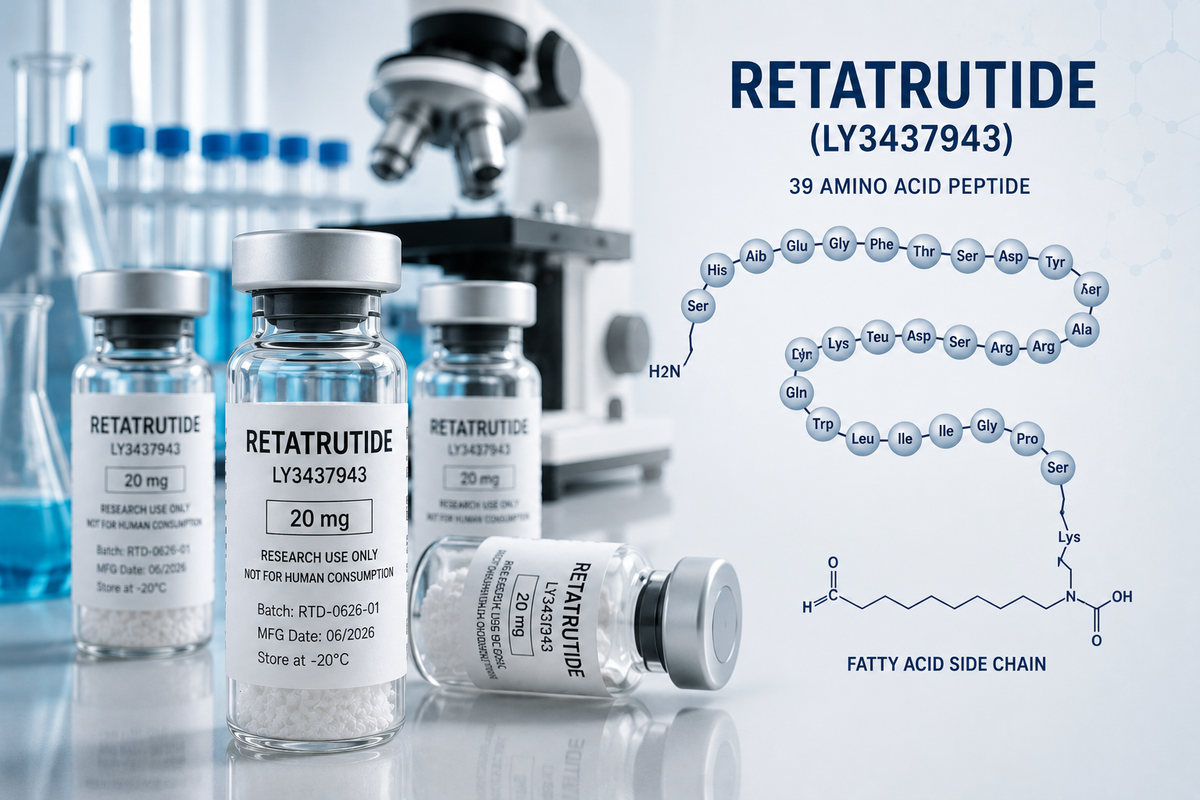
The molecule is commonly described as a 39-amino-acid peptide engineered from a GIP-related backbone. It also carries a fatty-diacid modification designed to support albumin association and extend circulation time. 2
The word “triple” refers to receptor pharmacology. It does not mean the vial contains three separate medicines.
In plain English: Retatrutide is one engineered peptide that has been designed to communicate with three related biological signalling systems.
Why the Three-Receptor Idea Matters
GLP-1, GIP and glucagon are naturally occurring hormone systems involved in digestion, blood-glucose regulation, appetite, energy balance and fuel mobilisation. Researchers designed Retatrutide to combine activity across all three.
That does not make the three pathways identical. Each receptor contributes a different part of the experimental pharmacology, and the overall effect depends on the precise balance of activity within the engineered molecule.
Retatrutide is not simply “a stronger GLP-1”. Its research interest lies in the deliberate balance of three receptor signals within one peptide.
Interactive Triple Receptor Explorer
Select each receptor to understand why scientists describe Retatrutide as a triple agonist. The explanations are simplified and do not represent personal medical advice.
GIP receptor
GIP is an incretin hormone released after eating. In research, GIP-receptor activity is studied alongside insulin secretion, nutrient handling and interactions with appetite and adipose-tissue biology.
Retatrutide’s GIP-related activity does not turn it into natural GIP. It remains a distinct engineered peptide.
Interactive Retatrutide Molecule Anatomy
The diagram shows a simplified 39-residue peptide chain. Select a feature to highlight its place in the molecular design. It is not a full chemical structure.
Interactive Retatrutide Research Timeline
Select a stage to see how the programme moved from early human pharmacology into large phase 3 trials.
Phase 1b
Early multiple-dose research in people with type 2 diabetes.
Phase 2 Diabetes
Randomised research compared several Retatrutide regimens with placebo and an active comparator.
Phase 2 Obesity
A randomised trial reported substantial average body-weight reductions over 48 weeks.
TRIUMPH Programme
Large phase 3 studies examined obesity and related conditions.
Phase 3 Results
Results emerged from diabetes and obesity programmes, while regulatory assessment remained separate.
What Changed in 2026?
The first phase 3 Retatrutide trial in type 2 diabetes, TRANSCEND-T2D-1, was published in The Lancet in 2026. It assessed efficacy and safety as monotherapy in adults whose diabetes was inadequately controlled by diet and exercise. 5
In May 2026, the manufacturer announced top-line results from TRIUMPH-1, a large phase 3 obesity trial. A press release is not the same as a complete peer-reviewed publication, so the full study report remains the more important scientific endpoint. 6
These developments strengthen the clinical evidence base. They do not make an unrelated online vial an authorised medicine or a copy of the sponsor’s study product.
The Retatrutide Evidence, Properly Graded
Use the tabs to separate molecular identity from human trial evidence and formal regulatory authorisation.
Molecular identity
Retatrutide is a defined synthetic peptide with a triple receptor profile. Identity evidence explains which molecule is being discussed. It does not establish that every vial using the name contains that molecule.
What the Human Research Shows
Early Human Pharmacology
A randomised multiple-ascending-dose study examined Retatrutide in adults with type 2 diabetes. Early trials are designed to explore pharmacology and tolerability, not to create a general consumer licence. 7
Glycaemic and Weight Outcomes
A 2023 randomised phase 2 study examined glucose control, body weight and safety across several regimens. The trial involved a sponsor-manufactured study drug under a defined protocol. 3
Forty-Eight-Week Findings
The 2023 obesity trial reported dose-dependent average reductions in body weight. Gastrointestinal adverse events were common, particularly during dose escalation. 4
A Broader Clinical Programme
The TRIUMPH and TRANSCEND programmes expanded the evidence base into larger populations and additional outcomes. Trial completion is still distinct from UK marketing authorisation. 8
What the Evidence Does Not Establish
- That an online research vial is equivalent to the material used in clinical trials
- That a high HPLC percentage proves pharmaceutical manufacture or sterility
- That a non-sponsor batch has the same impurity profile, stability or formulation
- That the compound may be prescribed in the UK before marketing authorisation
- That a product marketed as Retatrutide is lawful because it carries a Research Use Only label
University and Journal Science Behind Triple Agonism
Retatrutide sits within a wider academic story about nutrient-stimulated hormones, receptor signalling and the design of multi-receptor peptides.
The Phase 2 Obesity Trial
The lead author of the 2023 obesity paper was affiliated with Yale School of Medicine. The multinational trial involved academic and clinical investigators alongside the manufacturer. 4
Structural Biology
A 2024 structural study used cryo-electron microscopy to examine how Retatrutide interacts with GLP-1, GIP and glucagon receptors. The work helps explain how one peptide can recognise three receptor targets. 9
Glucagon-Based Therapeutics
Academic reviews place Retatrutide within a broader field of engineered glucagon-based medicines and multi-receptor designs. Reviews are useful for context, although they do not replace the underlying trial reports. 2
Official Medical Journals
Retatrutide results have appeared in two of the world’s leading peer-reviewed medical journals. Publication quality matters, but the exact study population, duration and product must still be read carefully.
Retatrutide Compared with Other Popular Peptide Names
These materials are often grouped together online. Their receptor profiles and regulatory positions are not the same.
| Material | General receptor profile | Current broad status | Important distinction |
|---|---|---|---|
| Retatrutide | GIP, GLP-1 and glucagon receptors | Investigational, phase 3 programme | Triple receptor agonist |
| Tirzepatide | GIP and GLP-1 receptors | Active ingredient in authorised prescription medicines | Dual rather than triple receptor agonism |
| Semaglutide | GLP-1 receptor | Active ingredient in authorised prescription medicines | Single receptor class |
| Mazdutide | GLP-1 and glucagon receptors | Separate development and regulatory history | No GIP receptor component in the stated profile |
| Survodutide | GLP-1 and glucagon receptors | Investigational | Different molecule and sponsor programme |
| Cagrilintide | Amylin analogue | Investigational in several contexts | Not a GLP-1, GIP and glucagon triple agonist |
Retatrutide and Tirzepatide
Tirzepatide is a dual GIP and GLP-1 receptor agonist and is present in authorised prescription medicines. Retatrutide adds glucagon-receptor activity and remains investigational.
A head-to-head phase 3 trial, TRIUMPH-5, was registered to compare Retatrutide with Tirzepatide in adults with obesity. A registered comparison trial does not make the two compounds interchangeable. 10
How Is Retatrutide Checked in a Laboratory?
A modified 39-residue peptide requires more than one headline purity number.
HPLC or UHPLC
Chromatography can separate detectable peptide-related components and report relative peak-area purity under a defined method.
Mass Spectrometry
Mass analysis can assess whether the main material is consistent with the expected modified peptide and attached side chain.
Peptide Mapping
Fragmentation methods can add evidence about sequence order, non-standard residues and modified regions.
Side-Chain Confirmation
The linker and fatty-diacid modification should be accounted for where complete identity is claimed.
Net Peptide Assay
The amount of Retatrutide should be distinguished from total dried material, water, salts and other substances.
Related-Substance Profiling
Truncated sequences, deletion products, oxidation, incorrect attachments and other synthesis impurities may require targeted evaluation.
What Should a Useful Analytical Record Include?
- The full name Retatrutide and development code LY3437943
- A clear definition of the intended molecular form
- The expected 39-residue peptide identity
- The non-standard residue and side-chain features
- The expected and observed molecular information
- The chromatographic method and result
- The batch or lot number
- The analysis date and issuing laboratory
- The net peptide assay where available
- An explanation of what the tests do not prove
Why 99% HPLC Is Not Enough
A high HPLC result does not automatically prove:
- That the main peak is Retatrutide
- That the sequence and attachment positions are correct
- That the material matches the clinical-trial product
- That the vial contains the stated net amount
- Sterility, endotoxin level or microbial quality
- Pharmaceutical-grade manufacture
- Suitability for administration
How to Compare Retatrutide Research Suppliers in the UK
Retatrutide creates an unusually high-risk supplier comparison because the name belongs to an investigational pharmaceutical compound with active clinical development.
Legal Business Identity
Look for a traceable company name, address, contact route and clear terms.
Exact Substance Description
An internal code such as RT20 is not enough to establish scientific identity.
Matching Batch Evidence
The vial, invoice and analytical report should refer to the same lot.
Identity Plus Purity
A chromatographic percentage should be supported by suitable molecular evidence.
No Medicine-Like Presentation
There should be no dosing, weight-loss promises, injection instructions or treatment comparisons.
No Sponsor Impersonation
An unrelated vial must not use branding, packaging or language that suggests it is the clinical-trial product.
Clear Quantity Basis
The stated amount should be explained as an analytical quantity, not a personal dose.
Recall and Complaint Process
A responsible supplier should be able to trace a batch and investigate documentation mismatches.
Particularly Serious Red Flags
- Claims that Retatrutide is approved, licensed or available on prescription in the UK
- Use of official trial logos, manufacturer branding or fabricated packaging
- Consumer weight-loss testimonials
- Before-and-after photographs
- Dose escalation plans, calculators or injection guidance
- Claims that a COA makes the vial equivalent to a regulated medicine
- Competitions, social-media prizes or coded sales language
Retatrutide UK Law and Enforcement
Retatrutide is not simply another generic laboratory catalogue entry. Its investigational pharmaceutical status makes the surrounding claims and supply model especially important.
No UK Marketing Authorisation Identified
No current UK marketing authorisation for a Retatrutide medicinal product was identified in the official sources checked on 18 July 2026.
A successful clinical trial does not itself grant permission to market a medicine. The manufacturer must submit a regulatory dossier and obtain the relevant authorisation before routine commercial supply as a medicine.
The MHRA Looks at the Whole Presentation
The MHRA considers composition, pharmacological properties, claims, intended purpose, images, instructions, reviews and overall presentation when deciding whether a product is medicinal. 11
Regulation 279 of the Human Medicines Regulations restricts advertising a medicinal product where the necessary authorisation, registration or certificate is not in force. 12
Current UK Enforcement Context
In May 2026, the MHRA reported its largest ever seizure of unlicensed weight-loss medicines. The agency stated that the operation involved suspected manufacture and distribution of Retatrutide, Tirzepatide and other peptide products. 13
The episode illustrates why a polished website, a research label or a purity certificate cannot replace lawful medicines manufacture and supply controls.
The same ingredient name does not make two products equivalent. Clinical evidence belongs to the exact study material, manufacturer, formulation and quality system used in the trial.
Continue Reading with It’s Me & You Clinic
The clinic’s companion article examines Retatrutide’s research status, testing questions and UK terminology in further detail.
Read the Retatrutide UK guideResearch Peptides UK Advisory Board
This article has been prepared for expert review. The titles below should be changed to “Reviewed by” only after each named person has approved this exact version in writing.
Dr Laura Geige
Prepared for Clinical Editorial Review
Proposed review of medical wording, public clarity and the distinction between an investigational medicine and general information.
Professional biographyDr Snieguole Geige
Prepared for Evidence Review
Proposed review of phase 1, phase 2 and phase 3 evidence and the limits of transferring trial findings to unrelated products.
Professional biographyDr Rimas Geiga
Prepared for Scientific Review
Proposed review of triple receptor terminology, molecular design and responsible interpretation of structural biology.
Professional biographyLivija Samušienė
Prepared for Scientific Terminology Review
Proposed review of peptide naming, molecular modification and accessible laboratory-testing language.
Professional biographyFrequently Asked Questions About Retatrutide UK
Clear answers about triple agonism, clinical trials, testing and the UK position.
What is Retatrutide?
Retatrutide is an investigational synthetic peptide, also known as LY3437943, designed to activate the GIP, GLP-1 and glucagon receptors.
Why is Retatrutide called a triple agonist?
It is one molecule with agonist activity at three receptor systems. It is not a mixture of three separate medicines.
How many amino acids are in Retatrutide?
It is commonly described as a 39-amino-acid synthetic peptide with additional structural modifications.
Is Retatrutide the same as Tirzepatide?
No. Tirzepatide is a dual GIP and GLP-1 receptor agonist. Retatrutide also includes glucagon-receptor activity.
Is Retatrutide the same as Semaglutide?
No. Semaglutide is a GLP-1 receptor agonist with a separate structure, evidence base and regulatory history.
Has Retatrutide completed phase 3 trials?
Phase 3 results have emerged from parts of the development programme, including a published diabetes trial and announced obesity-trial results. Other studies continue, and regulatory authorisation remains a separate process.
Is Retatrutide approved in the UK?
No current UK marketing authorisation was identified in the official sources checked on 18 July 2026.
Can a UK doctor prescribe Retatrutide routinely?
Retatrutide is not an authorised routine prescription medicine in the UK. Participation in an authorised clinical trial is a different legal and clinical setting.
Does a phase 3 result mean online Retatrutide is genuine?
No. A trial result concerns the exact sponsor-manufactured study product. It does not authenticate a separate online vial.
Does 99% HPLC prove that a sample is Retatrutide?
Not by itself. HPLC provides chromatographic information. Complete identity requires suitable molecular analysis and characterisation of the modified peptide.
Does a COA prove pharmaceutical quality?
No. A standard COA does not automatically prove sterility, validated manufacture, stability, clinical equivalence or lawful batch release.
Can a Research Use Only label make consumer sales lawful?
No. Regulators can consider the complete presentation, including claims, imagery, instructions, reviews and intended purpose.
Why are Retatrutide supplier claims especially sensitive?
Retatrutide is an active investigational pharmaceutical compound. Weight-loss claims, dosing language and medicine-like presentation can create serious legal and safety concerns.
Scientific and Official Sources
- Jastreboff and colleagues, New England Journal of Medicine: phase 2 Retatrutide trial in adults with obesity
- Journal of the Endocrine Society: glucagon-based therapies and Retatrutide molecular design
- Rosenstock and colleagues, The Lancet: phase 2 Retatrutide study in type 2 diabetes
- New England Journal of Medicine: triple-hormone-receptor agonist Retatrutide for obesity
- TRANSCEND-T2D-1: first phase 3 Retatrutide trial in type 2 diabetes
- Eli Lilly: May 2026 top-line TRIUMPH-1 phase 3 results
- ClinicalTrials.gov: early Retatrutide trial in type 2 diabetes
- ClinicalTrials.gov: TRIUMPH-1 phase 3 master protocol
- Structural insights into Retatrutide binding at GLP-1, GIP and glucagon receptors
- ClinicalTrials.gov: TRIUMPH-5 Retatrutide and Tirzepatide comparison
- MHRA: Borderline products and how to tell if a product is a medicine
- Human Medicines Regulations 2012, Regulation 279
- MHRA: May 2026 seizure involving suspected Retatrutide and other unlicensed products
- ClinicalTrials.gov: TRIUMPH-3 cardiovascular outcomes study
- Rationale and design of the TRIUMPH registrational clinical trials